
Rules
Part of Daily and seasonal quizzes: build the bank before the schedule
Scoring a recurring celebrity trivia quiz night: teams, disputes and tie-breaks
Scoring systems for a recurring celebrity trivia quiz night and the behaviors each rewards, why teams beat individuals, handling disputes, and tie-breaks that work.
A celebrity trivia quiz you run once can survive improvised rules. A celebrity trivia quiz you run every week or every holiday cannot. The second time, somebody remembers how you ruled last time, and the rules stop being yours to make up.
This site is about celebrity trivia and pop culture quizzes, so the scoring rules below matter most when your regulars are answering questions about actors, musicians, films, television, and internet fame. A celebrity quiz invites teams to debate who starred in what, which era a song belongs to, or whose signature is on the page.
The scoring system decides whether that debate is part of the game or a waste of time. Pick the one that rewards the celebrity knowledge your crowd actually enjoys showing off.
On a celebrity trivia site, the questions invite arguments about actors, musicians, films, television, and internet fame. Those arguments are the point. The scoring system should keep them alive rather than shut them down.
A rule that punishes a wrong guess can stop a table from debating a half-remembered film credit. A rule that rewards a team for betting on its strongest pop culture era can make that same table lean into what it knows.
The systems below work for any quiz, but they matter most when your regulars come for celebrity trivia and pop culture quizzes.
What to take away
- Write the scoring and dispute rules down before the first session, because a recurring quiz will test every gap in them.
- Every scoring system rewards a behavior. Decide which behavior you want before you pick one.
- Prepare the tie-break in advance. Inventing one at the end, in front of the people it will decide against, is the worst moment to design anything.
Scoring for celebrity trivia
Celebrity trivia has its own scoring pressure. Teams are not just recalling facts. They are arguing about who starred in a film, which decade a song belongs to, and whether a face is famous for acting, music, or an internet moment.
A scoring system should protect that argument. Negative marking punishes the guess that starts the debate. A joker or wager lets a table bet on its strongest area, such as 1990s sitcoms or chart-topping singles. For a celebrity quiz, whether daily or seasonal, rules should keep those pop culture debates alive and settle disputes about names, years, and credits.
Scoring systems and what they encourage
Points are not neutral. Each system tells teams how to play, and they will listen.
Scoring systems compared
System
- One point per correct
- Knowing things
- Harder worth more
- Depth over breadth
- Negative marking
- Caution
- Wager on a round
- Judging own knowledge
- Joker once per night
- Strategy on strengths
Rewards
- One point per correct
- Default, hard to beat
- Harder worth more
- Specialists win, generalists quit
- Negative marking
- Blank sheets, no guessing
- Wager on a round
- Drama, leaders can lose
- Joker once per night
- Good if categories announced
Produces
- One point per correct
- Harder worth more
- Negative marking
- Wager on a round
- Joker once per night
What it rewards
- One point per correct answer
- Knowing things
- Harder questions worth more
- Depth over breadth
- Negative marking for wrong answers
- Caution
- Teams wager points on a round
- Judging your own knowledge
- A joker or double played once per night
- Strategy about your own strengths
What it produces
- One point per correct answer
- The default, and hard to beat
- Harder questions worth more
- Specialist teams win, generalists disengage
- Negative marking for wrong answers
- Blank sheets, and the quiet death of guessing
- Teams wager points on a round
- Drama, plus a real chance the leaders lose on one round
- A joker or double played once per night
- Usually good, if the categories are announced first
Flat scoring is the strongest default and the least exciting to design, which is why hosts keep abandoning it. Before you do, be clear about what the alternative buys.
Weighting hard questions makes the result turn on the items with the least reliable answers. Negative marking removes the guess, and the guess is where a lot of the fun lives because a table talking itself into an answer is the game working.
The joker is the exception worth keeping. It adds a real decision without distorting the questions, and because the team chooses it, nobody can blame the format for the outcome.
Why teams beat individuals
A team of four will usually outscore the best individual in that team, and it is not simply because four people know more things. It is that the four know different things and can tell, roughly, which of them is likely to be right.
Pooling across people reliably beats most of the individuals pooled, a pattern usually filed under the wisdom of the crowd.
In a quiz, the pooling is explicit and audible. The interesting part is the second step: the confident member gets deferred to, the uncertain one gets overruled, and the table is often right about who to believe.
This has design consequences. Give teams time to talk, because the talking is the mechanism. Rush a round and you get four individuals writing in parallel, which scores worse and is far less enjoyable. Announce the category before the round so tables can work out who among them should lead it.
Handling disputes
Disputes are not a sign of a bad quiz. They are a sign of a room that is paying attention. What matters is that they resolve fast and consistently.
Three rules cover almost all of it:
- The host rules, and the ruling stands for the night. Not because the host is right, but because the alternative is a debate with no end condition.
- If the question was ambiguous, void it for everyone rather than awarding it to whoever complained. A voided question is an admission that costs you nothing and buys you a great deal of credibility.
- If a team is right and the answer key is wrong, say so out loud and correct it in front of the room. Quietly adjusting a score afterward is how a recurring quiz loses people.
Write down every ruling as you make it. In a weekly or seasonal game, it becomes your house rulebook within a couple of months.
The point is not the rules but that they stop changing. Give the marking policy the same treatment. The answer-key discipline for celebrity signatures by profession is the practical version.
Tie-breaks that actually work
A tiebreaker has one job: to separate two teams quickly and without feeling arbitrary. Most fail at the second part.
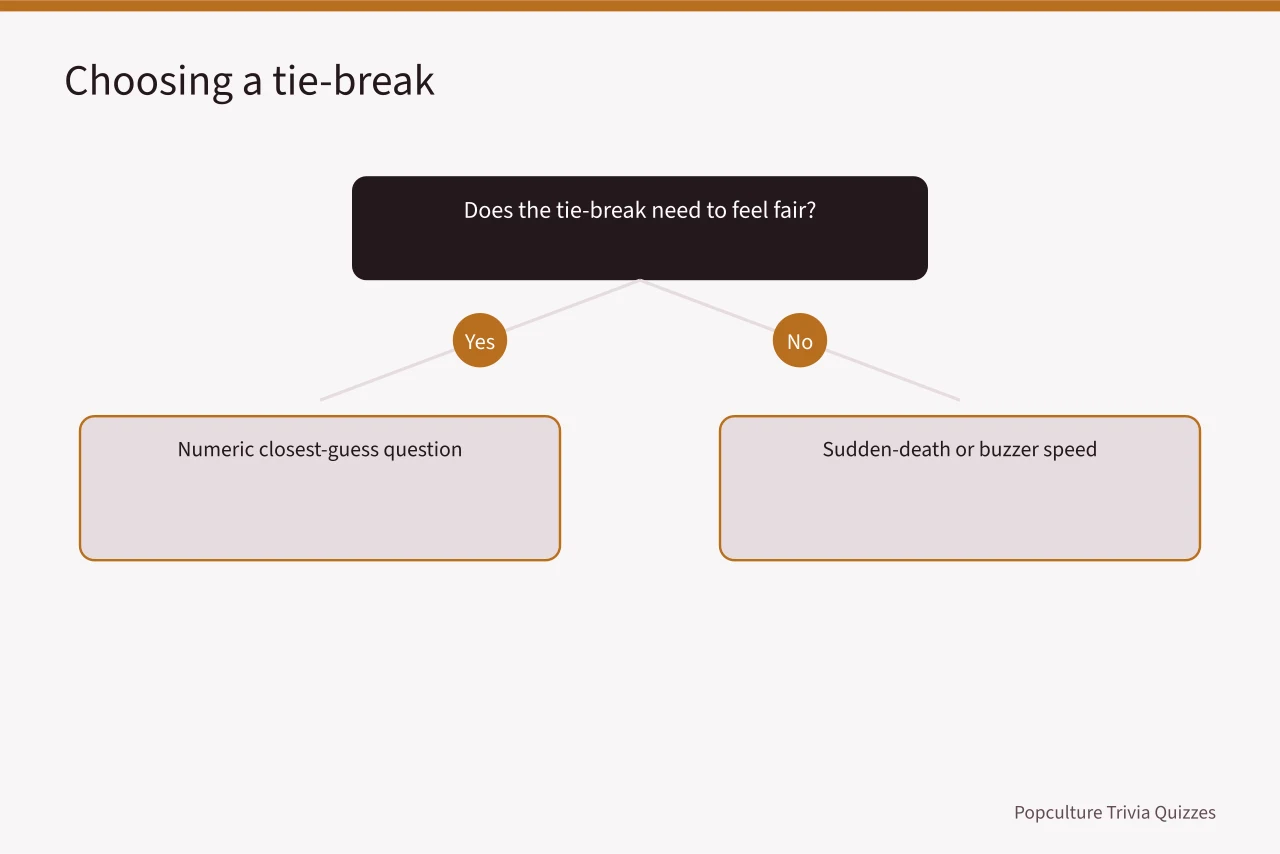
What works is a question with a numeric answer where the closest guess wins. Nobody knows it exactly, everybody can reason toward it, and there is always a winner. Prepare two of these, since the first one occasionally produces another tie.
What does not work: sudden-death questions from the ordinary bank, which turn the whole evening on one item and are usually decided by luck.
Speed on the buzzer, when the rest of the quiz was written, fails. Counting back through earlier rounds is fair but feels like arithmetic, not a finish.
Say the tie-break rule at the start of the night, not at the end. A rule announced in advance is a rule. The same rule announced when it is about to be applied is a decision, and it will be read as one.
Running the same game repeatedly
A recurring celebrity quiz has one resource problem: celebrity questions get used up faster than you can write them, and the temptation is to lower the standard rather than the frequency.
Rotate formats. The same bank of celebrity questions yields several different evenings when you change what is asked of people, not what they are asked about.
Keep a running list of what ran when, so a returning crowd does not meet the same round twice in a season. Hold difficulty steady across sessions. A regular audience notices variation in difficulty far more than a one-off crowd does.
Common questions
How many points should a whole celebrity quiz be worth?
Enough that a single question cannot decide it. Forty to sixty across the night is a reasonable range, which leaves a wrong ruling on one item as an annoyance rather than a result.
Should scores be read out between rounds?
Yes, except before the last round. Running scores keep tables invested. Hiding the final standings until the end preserves the finish without hiding the whole game, and it stops a leading team from playing safe. The wider running order this fits into is set out under awards trivia party game.
Can teams be different sizes?
They can, and a point handicap for larger teams sounds fairer than it plays. Pooling returns diminish quickly, so a team of eight is not twice a team of four. Capping the size is cleaner than adjusting the scores.
How do I keep a seasonal celebrity quiz from repeating itself?
Build a bank across the year rather than before each event, and pull from it. A themed night still needs the same range of difficulty, and the material in a daily and seasonal quizzes questions file is easier to grade once there is enough of it to choose from.
What if one team wins every week?
Look at your questions before you change the scoring. A team that always wins usually means the celebrity quiz is testing one thing, and the fix is a round that rewards a different skill rather than a handicap. Adding depth in one area, as a hard celebrity career quizzes round does, tends to work better than making everything harder.