Guides
Canadian Celebrity Obituaries in US Quiz Nights: Which Deaths Get Asked
How US quiz hosts choose which Canadian celebrity deaths to ask about, how to phrase respectful obituary questions, and where a themed round can go wrong.
What to take away
- US quiz hosts draw from a short list of Canadian deaths: Alex Trebek, Gord Downie, Leonard Cohen, Neil Peart, John Candy, plus hockey names such as Gordie Howe and Maurice Richard.
- The safest questions pair a documented death year with one verified role, and avoid the manner of death.
- Respectful wording names the person, the year, and the work, and skips illness, family, and funeral details.
- Verify every date before the round runs, because a wrong death year is the fastest way to lose a room.
- Build the pool from a published list of notable Canadians so the round does not drift back to US defaults.
Which Canadian deaths US quiz hosts actually ask about
The most-asked Canadian obituary question in US rooms is Alex Trebek. The 'Jeopardy!' host was born in Sudbury, Ontario, in 1940 and died on November 8, 2020. Hosts like him because the answer is a household name and the death year is simple to check.
Canadian deaths US hosts ask
- 1994John Candy
- 2000Maurice Richard
- 2014Jean Beliveau
- 2016Leonard Cohen, Gordie Howe
- 2017Gord Downie
- 2020Alex Trebek, Neil Peart
- 2021Norm Macdonald
Gord Downie of the Tragically Hip follows close behind. He was born in Kingston, Ontario, and died on October 17, 2017. Leonard Cohen, born in Montreal, died on November 7, 2016. Neil Peart, the Rush drummer, died on January 7, 2020.
Film and television supply John Candy, who died in 1994. They also supply Canadian-born performers many US players assume are American: Phil Hartman, Peter Jennings, and Lorne Greene.
Hockey fills the rest. Gordie Howe died in 2016, Maurice Richard in 2000, and Jean Beliveau in 2014. Norm Macdonald, born in Quebec City, died in 2021.
The reverse list matters just as much. Celine Dion, Michael J. Fox, Mike Myers, and Rick Moranis are all living, and a host who asks otherwise will hear about it.
Start from a citable List of Canadians so the pool stays defensible. Death dates are where hosts slip. Fact-checking practice applies directly: compare a news obituary with a reference entry before writing the question. Where a legal name matters rather than a stage name, official vital records settle it.
Phrasing a respectful question
A workable obituary question has three parts: the person, one verified role, and one date. 'Which Canadian-born Jeopardy host died in 2020?' does that in ten words.
Three parts of a respectful question
- Name the person
- Name one verified role
- Give one death date
- Avoid 'what really happened to'
- Avoid stacking two deaths
- Avoid 'before they died' framing
Avoid openers that invite speculation, such as 'what really happened to.' Avoid stacking two deaths in one question. Avoid 'before they died' framing, which makes the death the subject rather than the career.
Name the person, name the work, give one date, and let the room supply the name. Anything beyond that is a different kind of question.
Example round: five Canadian obituary questions
Example round
- Which Canadian-born host of a long-running US quiz show died on November 8, 2020? Answer: Alex Trebek.
- Which Tragically Hip frontman died on October 17, 2017? Answer: Gord Downie.
- Which Montreal songwriter behind 'Hallelujah' died in 2016? Answer: Leonard Cohen.
- Which Rush drummer died on January 7, 2020? AnswerNeil Peart.
- Which Ontario-born SCTV star of 'Planes, Trains and Automobiles' died in 1994? Answer: John Candy.
Each question names a role, gives one date, and asks for a name. None of them asks how the person died. Read the block aloud first and drop any line that draws a groan. The practical detail is set out in A Celebrity Real Names Quiz Only.
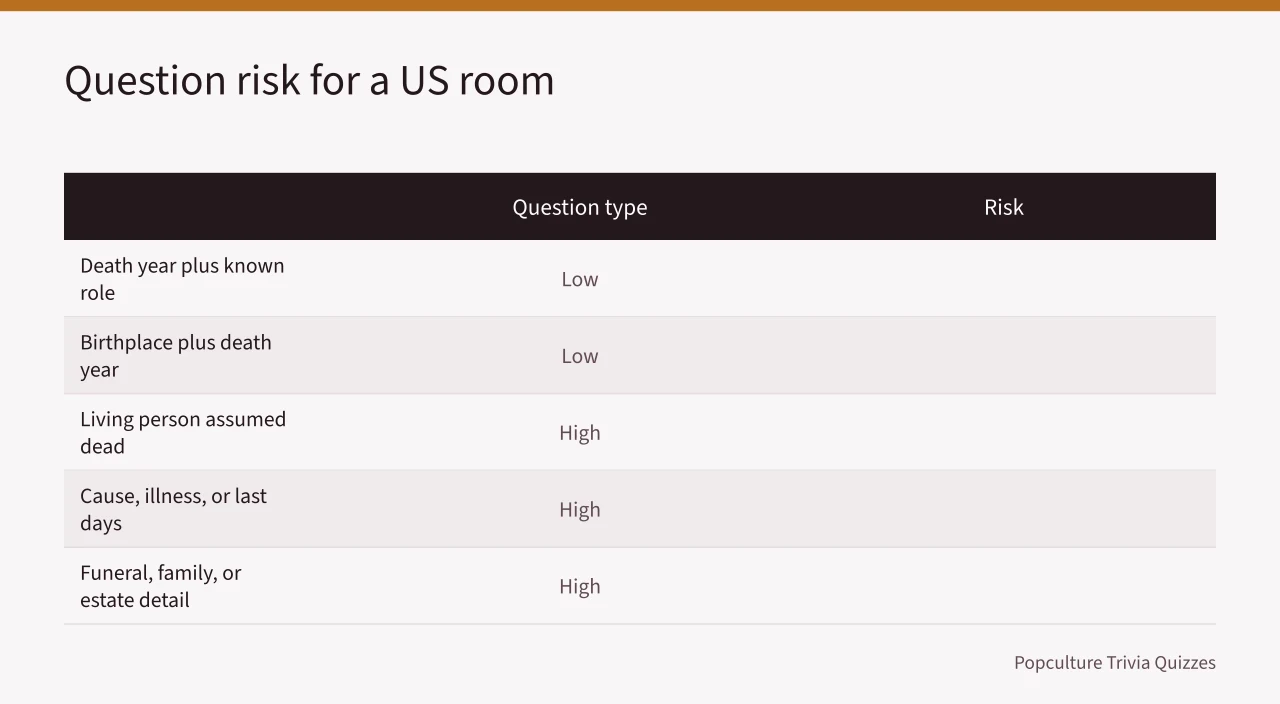
Question types and their risk level
Question types and risk
| Question type | Sample subject | Risk for a US room |
|---|---|---|
| Death year plus a known role | Neil Peart, 2020 | Low |
| Birthplace plus death year | Alex Trebek, Sudbury | Low |
| A living person assumed dead | Celine Dion | High |
| Cause, illness, or last days | any subject | High |
| Funeral, family, or estate detail | any subject | High |
Pre-round checklist for hosts
Pre-round checklist
- Confirm the death date against two independent published sources.
- Confirm the person is actually dead before the round goes to print.
- Confirm the Canadian connection, whether by birth, upbringing, or long residence.
- Cut anything about cause of death, family members, or final days.
- Read the full question aloud and remove anything that sounds like a punchline.
Where a round goes wrong
Three failures repeat. The first is a cause-of-death question, which turns a quiz into gossip. The second is a joke built on an illness, which is where a room turns cold. The third is a guess about a living performer.
Company quiz nights carry extra weight. If the event is a workplace function, harassment rules apply to the content as well as the conduct. Keep obituary questions to dates, roles, and work.
Hosts building a full themed round will find life-date sourcing, five-question blocks, and sample rounds and pricing tax notes in the companion guide.