Costs
Part of Collecting photos for childhood photo games without a consent mistake
Childhood Photo Games by Decade: Date the Print
Childhood photo games by decade work best as object rounds: print formats, borders and color processes date a snapshot far better than a face does.
Sort childhood photo games by decade and you find you have not made a round about people at all. You have made a round about photography: about what cameras ordinary families owned, what the prints came back looking like, and how the results were kept.
That is a better round than the one you set out to write, and it is far easier to defend. The period of a print is a physical property with documented history behind it. The period of a childhood is a fact about a person that you probably should not be asking for anyway.
What to take away
- What a snapshot is made of dates it. What is in it does not, except by inference nobody can check.
- For the version played on the room, the subject's own photograph is theirs, and the period on the sheet is whatever they are willing to say it is.
The object carries the date
A snapshot is a manufactured thing before it is a picture of anything, and manufacturing changes on a schedule.
The format is the strongest signal. Frame proportions have shifted with camera formats, and the shape of a print is often enough to put it in a band of years without looking at the subject at all. Film format history is documented in detail, which is exactly what an answer key needs.
Laid out by decade, the common household formats and their print habits look like this.
| Decade | Common format | Border and edge | Process and color |
|---|---|---|---|
| 1900s to 1920s | 4x5 in and 3.25x4.25 in contact prints, cabinet cards | card mount, square corners | gelatin silver and albumen paper, cyanotype, sepia toning |
| 1930s to 1940s | 120 and 620 roll film, 2.25x3.25 in and 3.5x3.5 in | white border, deckle or plain edge | black and white gelatin silver, Kodachrome slides from 1935 |
| 1950s | 620, 2.25x2.25 in square | white border, scalloped edge | black and white, plus early Kodacolor negatives on type C paper |
| 1960s | 126 cartridge, 3.5x3.5 in square | white border, rounded corners | Kodacolor-X era color on chromogenic paper |
| 1970s | 110 cartridge and 35mm, 3.5x5 in and 4x6 in | thin white border, or none | C-41 color negative, resin-coated paper |
| 1980s | 35mm, 4x6 in | white border with a print code, glossy or matte | Kodak Gold and Fujicolor, one-hour lab finishing |
| 1990s | APS, 4x6 in and 4x7 in | rounded corners, date printed on the back | C-41, plus the first digital camera prints |
| 2000s onward | inkjet and dye sublimation, 4x6 in | borderless, no edge | pigment and dye inks, EXIF data in the file |
Treat the bands as typical rather than fixed. Cartridge cameras stayed in drawers for years, and labs kept old paper stock in use until it ran out.
The surface tells you almost as much. Border or no border, matte or glossy, a deckle edge or a cut one, a date printed by the processor, a maker's mark on the back of a fiber-based or resin-coated paper: these are all production decisions with periods attached.
Color behaves like a clock. Whether a family snapshot is in color at all, and how the color has shifted since, both depend on processes that entered and left ordinary use at known times. C-22 color negative film gave way to C-41 in the 1970s.
Dye layers fade in a characteristic direction, so the way an old print has gone wrong is itself information.
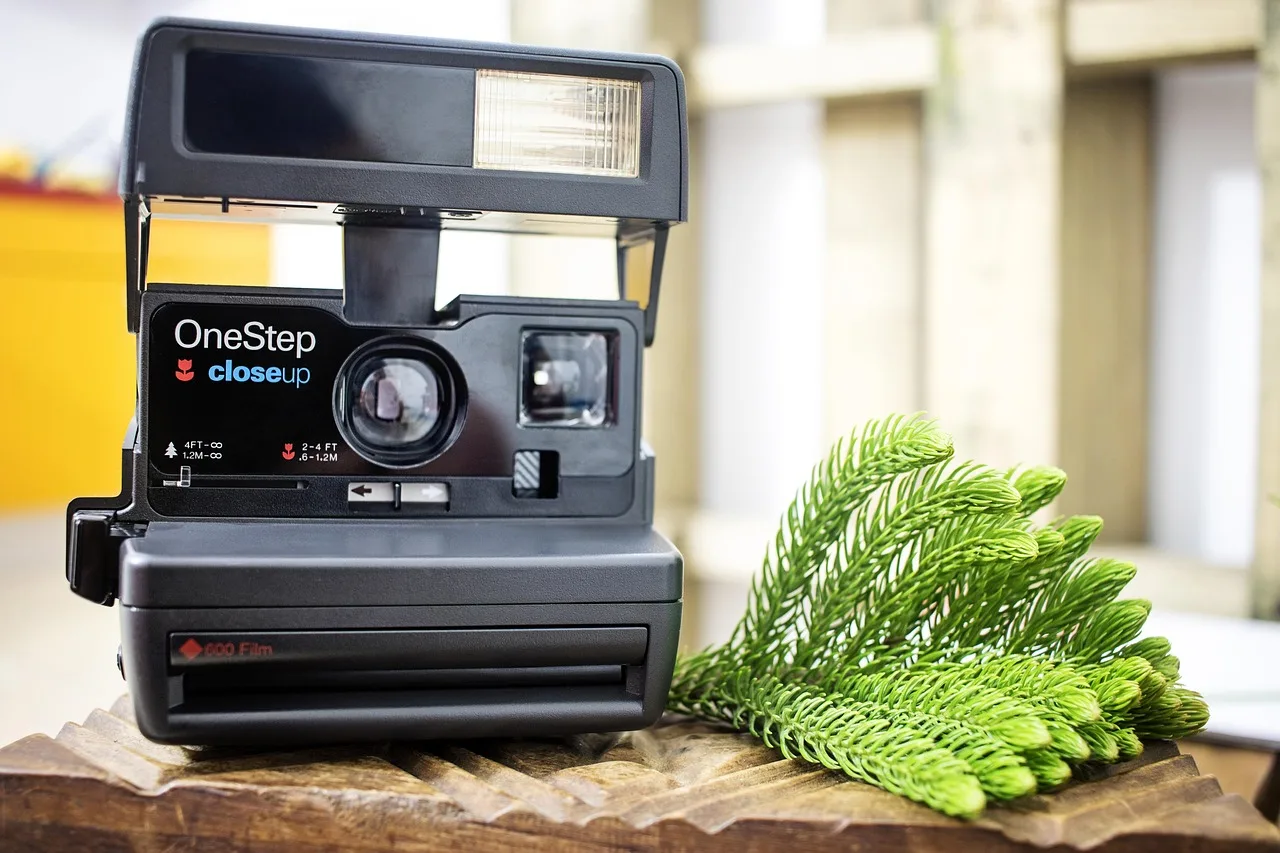
Instant prints are their own category. An image on instant film has a shape and a border that nothing else has, and a household that owned such a camera was doing something specific with photography.
Digital images have the reverse problem. The physical clues are gone, replaced by EXIF data that survives only until the file passes through anything that re-saves it.
Turning that into questions
You can build the whole round without asking about a single person.
Ask what format a print is, judging by its proportions and edge. Ask which of four prints is oldest and why, with the reasoning as the point.
Ask what a mark on the back of a print means. Ask what a family with a particular kind of camera had to do to see its pictures, and how long that took.
Each of these has a definite answer that lives in the history of photographic manufacturing rather than in anybody's biography. Each is answerable by reasoning, so the room is not divided into people who happen to know a fact and people who do not.
And each of them can use an image where the subject is incidental, cropped out, or absent. That solves the hardest sourcing problem in this whole area in one move. The image handling itself does not change from the standards in photo quizzes.
One item, written out in full:
- Question: "This print measures 3.5 by 3.5 in and has a white border with rounded corners." Which cartridge format does it point to, and roughly when was that format sold?
- Answer: 126 cartridge film, which Kodak introduced with the Instamatic camera in 1963 and sold for more than two decades. The square frame and the 3.5 in print are the tell.
- Format: one image, no visible face, four answer choices.
- Source: a collection catalogue record that names the format, plus a published film format history.
- Date checked: the day the sheet was written, entered beside the source on the answer key.
The version played on the room
If the photographs are coming from the people present, the decade axis needs a different treatment, because you are now asking about their childhoods rather than about paper.
Put on the sheet only the period the person will state. Ask for it in one line with the photograph, and use the answer exactly as given.
Somebody who prefers a wide range, or none at all, gets what they asked for, and the item is written to suit. Do not infer age from an image, or ask the room to guess it.
Asking what kind of print somebody brought, or what the processing date on the back says, is a question the owner has volunteered the answer to. The same handling rules apply here as in childhood photo games, and none of them relax because the axis is time rather than identity.
And exclude anyone who is not in the room to agree. A photograph is of a child, and a child who is not present, not an adult, and not a public figure has no way to be asked.
Sourcing images for the object round
For the version about formats and paper, you want images that are held and described by somebody rather than found.
Collections that document photographic processes describe what they hold, with the format and the process named. That description is your answer key, and it was written by somebody whose job was to be right about it.
Reference images of formats and papers, rather than of families, are the cleanest material of all: a picture of a print with nobody visible in it is both easier to source and easier to defend.
Avoid material scraped from listings and social posts. There the caption is a guess and the file has been through several re-saves.
Captions are the claim of the last person to touch the image. That point is in photo quizzes facts, and it applies here. A wrong format claim stays invisible until somebody who knows formats is in the room.
Write the process, the source and the date you checked on the answer sheet, the way photo quizzes by decade recommends for any era round.
The celebrity photograph that fills a quiz round is the same problem in a louder costume: a caption nobody verified, attached to a file that has been re-saved a few times. Where the caption and the print disagree, the print is the claim that counts.
Common questions
Can I date a print just by how faded it is?
Only loosely, and it depends on storage as much as on age. A print kept in a drawer and a print kept on a wall for the same years look decades apart, so fading supports a range and never a year. A chromogenic print in a closed album holds its color better than one framed in daylight.
Is the object round less fun than guessing who is in the picture?
It is a different pleasure and it plays better with a mixed room, because reasoning from evidence is something everyone can join in. A row of four prints sorted oldest first, each with a reason given, is a complete round. It also does not require you to have a defensible photograph of anybody.
What about scanned copies of old prints?
A scan keeps the proportions and usually the border, and loses the surface and the back. A flatbed scan at 300 ppi, which is typical, drops a deckle edge and any mark on the back. Say what you are showing, and do not ask questions that depend on properties the scan has thrown away.
Should I ask what decade a person in the picture was born?
No. That is a question about a private fact and it is guesswork dressed as a question, whoever the subject is. Ask what format the print is instead, and the print answers.
How do I keep the round from becoming a photography lecture?
Ask for judgments rather than for names. Which of these is older, and why, is a game. What this process was called and when it was introduced is a lecture, and one such question per round is the limit. Put the process name on the answer sheet, not in the question.