Reviews
Part of Collecting photos for childhood photo games without a consent mistake
Childhood photo games questions: signal versus noise
Childhood photo games questions: a fair prompt identifies the star or asks about visible details, not private childhood. Use this signal-versus-noise test.
Getting permission to use somebody's childhood photograph is one decision. On this celebrity trivia and pop culture quizzes site, that is usually a childhood photo of a famous person. Deciding what question to put underneath it is a second one, and it is the one that gets skipped.
Celebrity trivia and pop culture quizzes lean on childhood photos because a baby picture of a famous actor, singer, or athlete is an instant hook. The game only works when the question tests recognition of that star, not details of a private childhood.
A fair celebrity trivia round asks players to name the famous face, match the star to a known role, or spot a pop culture icon from a school portrait. That keeps the fun on the celebrity and off the life.
If the question is careless, the round stops being a celebrity trivia game and becomes a gossip exercise, which is not the celebrity trivia this site is for. The guidance below is for quiz makers who want the famous face to carry the fun without turning a childhood photo into a story about a private life.
Famous faces make the question feel harmless. It is not. The same rule applies to a celebrity childhood photo as to a private guest: the image can be cleared and the sentence under it can still be the problem.
Somebody can be entirely happy for their photograph to be in a round and entirely unhappy about what you attached to it. By the time you find out, the room has already read it out.
What to take away
- Signal:identify the person in a cleared photo, match the star to a public role, or ask about harmless details visible in the image.
- Noise:probe private family facts, body changes, dates, or judgments about a child.
- Permission for the image and permission for the exact question are separate. A child in the frame who did not agree to be included is not part of the round.
The image and the question are different asks
When you request a photograph, say what the question will be. Not the topic, the actual sentence, or as close to it as you can get before the set is finalized.
Send the question before the set
- Say the actual question sentence
- Owner says fine, suggests change, or withdraws
- Late setsend question shape instead
- State what the reveal will say out loud
That one habit removes almost every problem in this format. A person reading the question in advance can tell you it is fine, can suggest a different one, or can withdraw, and all three of those are cheap before the evening and expensive during it.
It also disciplines the writing. A question you would not send to the person it is about is a question that should not be on the sheet, and the test takes a second.
Where the set is assembled late, send the question shape rather than the sentence: what the room will be asked to do, and what will be said out loud when the answer is revealed. The reveal is the part people forget to ask about, and it is the part that is heard by everybody.
What the question may ask about
Signal means the answer identifies the star or describes something harmless and visible in the photograph. Noise asks players to infer private facts or judge the child in the image.
Safe question material
- Who this is, from a closed list
- The picture as an objectprint, date, place
- Something visible and harmless in frame
- The owner's own suggested question
Ask who this is, from a closed list of people who agreed to be included and whose image use is cleared. That tests recognition without inviting guesses about a private childhood.
Ask about the picture as an object. What kind of print it is, roughly when it was taken if the owner supplied that, where it sits among the others. These are answerable and the owner supplied the facts.
Ask about something visible and harmless. What is in the background, what somebody is holding, what the weather appears to be doing. This is the lightest material in the round and it plays well.
Ask the owner's own question. Somebody who is enjoying the game will often supply a better prompt about their own picture than you would have written, and it comes with its permission attached.
A celebrity version could use a childhood image of Taylor Swift only if that specific image is cleared for the quiz and approved for the question. Ask, “Which singer is pictured?” That is signal: it tests identification, not private history. Another approved question might ask what is written on a birthday cake when the answer is visible in the frame.
What the question may never ask about
Noise starts when a prompt moves from identifying the public figure or noticing the image to probing private life, comparing bodies, or inviting the room to judge a child.
Never ask about these
- Family circumstance or who else was there
- Body, weight, height, features, change
- Anything inviting the room to judge
- Date of birth or age
- Another child in the frame
Nothing about a family circumstance. A photograph of a child is also a photograph of a household. And questions about who else was there, what was happening, or what changed afterward are questions about people who are not in the room.
Nothing about a body. Weight, height, features, and how somebody has changed physically are not quiz material at any age and least of all about a child.
Nothing that invites the room to judge. A prompt asking who was the most anything, based on a childhood picture, is a ranking of the guests wearing a photograph as a costume. The career quizzes party game format avoids that shape on purpose.
Nothing about a date of birth or an age. That is a sensitive identifier rather than a fun fact, and a round that reconstructs it from pictures has produced something nobody asked it to produce.
Nothing about another child in the frame. Siblings, cousins, friends and classmates did not give you anything. And the right to privacy of a person who was a child in somebody else's photograph does not disappear because the photograph was shared with you.
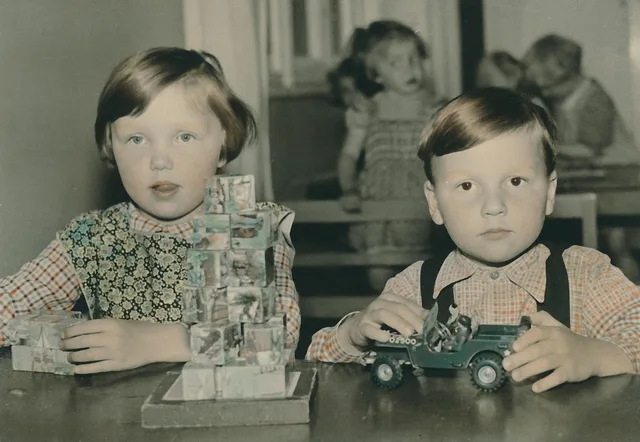
A rejected question looks like this. The photograph shows two children on a beach. The question is: which of them became the taller adult? That ranks people by their bodies, and the picture does not answer it.
Children who are not there to agree
Is this picture usable?
Did the person, as an adult, choose to be a public figure?
check the second question
not usable, however easy to find
A person who is publicly known as an adult may have published childhood photographs. That does not automatically grant permission to reproduce one in a quiz: confirm the image rights with its photographer or rights holder. Getty Images is one possible licensed-image source, but check that the specific license covers your quiz use.
A child publicly visible only because of who their family is has published nothing. The material about them exists because of somebody else's fame.
Children's rights law names the standard: the UN Convention on the Rights of the Child, Article 16, protects a child's privacy, family and home. A quiz round is a poor place to make an exception.
For this editorial standard, ask whether the pictured person is an adult who chose to be a public figure and chose to publish that childhood image. If either answer is no, leave the photo out. If both are yes, you still need to clear the image rights and any applicable legal permissions.
Apply that test to every image: the adult subject chose to make this childhood photo public, and the quiz maker has cleared its use. Otherwise, leave it out. The broader game setup is covered in childhood photo games.
Wording the question so it survives the room
Beyond the ethics, several small wording habits keep this round from going wrong out loud.
Wording habits that hold up
- Number images, refer by number only
- Write the reveal, never improvise it
- Keep the question short
- Give the answer without commentary
Number the images and refer to them by number only. Names read out before the answer spoil the round and, in the guest version, out somebody who had not been identified yet.
Write the reveal, do not improvise it. What you say when you confirm an answer is heard by the whole room, and an improvised aside about a picture is where the unplanned remark comes from.
Keep the question short and give the answer without commentary. Long prompts about a personal photograph invite the host to add color, and color is exactly the thing nobody consented to. The reveal is a name and a number.
Anything else you were about to add belongs to the person in the picture, and the demand that a question have one plain answer, made in guess the celebrity questions, is doing double duty here.
Use an image licensed or otherwise authorized for reproduction in your specific quiz, and check that it remains legible at the size you display it. The photo quizzes guide covers image presentation.
Common questions
Do I need permission for the question if I already have it for the photo?
Yes, and asking for both at once takes no longer than asking for one. The image and the sentence under it land on the person differently.
What if somebody objects during the round?
Pull the item immediately, adjust the scoring so no team is penalized, and do not explain. Any explanation makes the objection public, which is the thing the person was trying to avoid.
Can I keep a good question and swap the photograph?
Only with the new owner's agreement. The question was approved by one person about their own picture, and it does not transfer.
Is it different if everyone in the room knows each other?
It is easier to collect and no different in what may be asked. Close groups produce the most careless prompts, because everyone assumes the material is shared when some of it is not.
Should the answer sheet record who agreed to what?
Yes. Keep one answer-sheet record per item: photo identifier and source, image-use permission or license, the pictured person's agreement to the exact question, and the final wording. That record helps you resolve questions afterward and delete the set cleanly when the evening is over.